SEO vs Google Ads for Contractors: Which One Actually Brings You Paying Clients?
For contractors weighing SEO vs Google Ads, the short answer is this: Google Ads delivers leads fast but stops the moment you stop paying, while SEO builds compounding visibility that generates calls for years. Most contractors benefit from understanding the real cost and performance differences before committing a budget to either channel.
For contractors weighing SEO vs Google Ads, the short answer is this: Google Ads delivers leads fast but stops the moment you stop paying, while SEO builds compounding visibility that generates calls for years. Most contractors benefit from understanding the real cost and performance differences before committing a budget to either channel.
You're running a contracting business. You need the phone to ring. Someone tells you to "just run Google Ads" and someone else says "you need to invest in SEO." Both sound reasonable. Both cost money. So which one actually works for contractors, and which one is quietly draining your budget without delivering real results?
This breakdown cuts through the noise and gives you the honest comparison you need to make the right call for your business.
Key Takeaways
- Google Ads can generate leads within days, but the cost per lead in competitive contractor markets is often high enough to erode profit margins significantly.
- SEO takes 3 to 9 months to gain traction but produces leads at a fraction of the ongoing cost once rankings are established.
- When you stop paying for Google Ads, your visibility disappears immediately. SEO equity remains and continues working.
- Homeowners increasingly trust organic search results over paid ads, which affects both click-through rate and conversion quality.
- The most effective contractors use a phased approach: ads for short-term cash flow, SEO for long-term profitability.
- Your market size, competition level, and average job value should heavily influence which channel you prioritize first.

What's the Real Difference Between SEO and Google Ads for Contractors?
At the surface level, both channels put your business in front of people searching for contractors on Google. The mechanics underneath, though, are completely different.
Google Ads operates on a pay-per-click model. You bid on keywords like "roof replacement near me" or "licensed electrician in [city]," and your ad appears at the top of search results. Every click costs you money whether or not that visitor becomes a client. SEO, by contrast, is the process of earning those top positions organically by making your website more relevant, trustworthy, and technically sound than your competitors.
One channel rents visibility. The other builds it.
The Speed vs. Sustainability Trade-Off
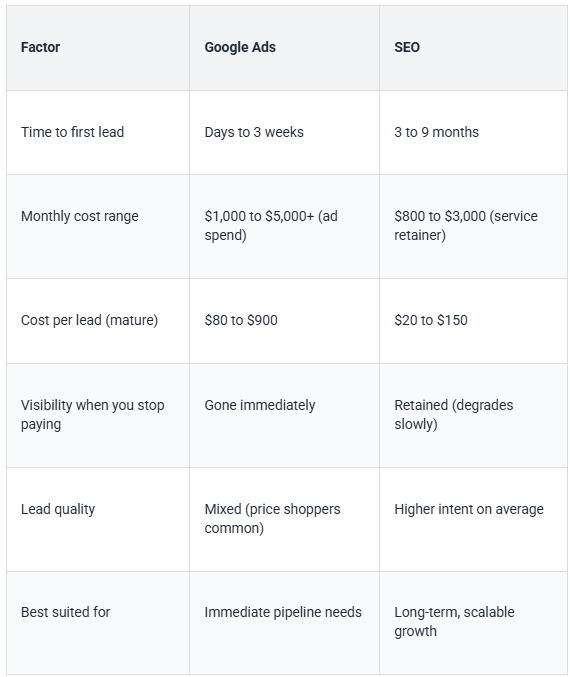
Google Ads campaigns for contractors can be live quickly, with leads potentially arriving in the first weeks. SEO for contractors typically requires 3 to 9 months before significant ranking movement occurs, and 6 to 12 months before a consistent lead flow develops. The timeline depends heavily on how competitive your local market is and the current state of your website.
This gap matters a lot depending on where you are in your business. A newer contracting company that needs revenue immediately has a different calculus than an established business trying to reduce its dependence on paid traffic.
How Much Does Each Channel Actually Cost Contractors?
Cost comparisons between SEO and Google Ads require looking at both upfront spend and cost per acquired client, not just monthly budget numbers.
In competitive contractor markets, Google Ads cost-per-click for keywords like "HVAC repair," "roofing contractor," or "kitchen remodel" typically ranges from $8 to $45 per click. With average contractor landing page conversion rates sitting around 5 to 10%, that can translate to $80 to $900 per lead before any service is delivered. High-ticket trades in dense metros often land at the upper end of that range.
SEO services for contractors typically run $800 to $3,000 per month depending on market competition and scope of work. However, once strong rankings are achieved, the cost per lead drops dramatically because you're not paying for each individual click. Contractors who rank in the top three positions on Google for their core service keywords often report a cost per lead that is 60 to 80% lower than their equivalent Google Ads spend.
Which Channel Do Homeowners Actually Trust More?
This is where most comparisons get it wrong. Trust is a real conversion factor, not just a soft metric.
Studies consistently show that organic search results receive significantly more clicks than paid ads for most contractor-related queries. Depending on the source, organic results capture 60 to 80% of search clicks, while paid ads capture the remainder. For high-trust purchases like home renovation or roofing, homeowners often scroll past ads deliberately because they associate organic rankings with credibility and peer validation.
Think about what it means when someone is about to spend $15,000 on a kitchen remodel. They're not clicking the first ad they see and pulling out a credit card. They're searching, reading reviews, checking websites, and comparing. The contractors who show up organically with solid reviews, local content, and authoritative sites tend to win that evaluation process more often.
That's not an argument against ads. It's an argument for understanding what each channel is actually good at.
The Hidden Risk of Going All-In on Google Ads
Contractors who rely exclusively on Google Ads are building their pipeline on rented land. There are three specific risks that don't get discussed enough.
- Budget dependency: Your lead flow is directly tied to your spend. During slow months when cash is tight, you may cut the budget precisely when you need leads most, compounding the problem.
- Auction volatility: When competitors increase their bids or a new contractor enters your market, your cost per click rises. You can see your lead costs double within a month without changing a single thing on your end.
- Zero asset building: Two years of Google Ads spend builds zero cumulative value. Two years of SEO investment builds domain authority, content, and rankings that continue generating returns.
None of this means Google Ads is a bad channel. It means relying on it exclusively is a fragile strategy.
How to Decide Which One to Prioritize First
The right starting point depends on a few honest questions about your business right now.
- Assess your current revenue situation. If you need work within the next 30 to 60 days to cover payroll or overhead, SEO cannot help you in that window. Google Ads is the right short-term move.
- Calculate your average job value. If a typical project pays $500, a $200 cost per lead makes ads unworkable. If a project pays $8,000, that same $200 lead cost is very manageable while you build SEO over time.
- Research your local competition online. Search your core service keyword in your city and look at who ranks in the top three organic results. If those positions are held by weak, outdated websites, SEO is a faster opportunity than it would be in a saturated market.
- Check your website's current state. Google Ads will send traffic to your site whether it converts well or not. Before spending money on ads, make sure your site has a clear call to action, loads quickly on mobile, and features real photos and reviews. A weak website wastes both SEO and ad budget.
- Set a 12-month horizon. Plan where you want to be a year from now. If the goal is to reduce paid ad dependency, start seo for contractors now even at a modest investment level, and use ads to bridge the gap.
Common Mistakes Contractors Make With Both Channels
- Running ads without tracking calls or conversions. Many contractors spend $2,000 a month and have no idea which keywords are actually producing leads. Without call tracking and conversion data, you're flying blind.
- Expecting SEO results in 60 days and quitting. Contractors who invest in local seo for contractors and abandon it after two months lose both their investment and the compounding progress that was starting to build.
- Ignoring Google Business Profile while doing either. Your Google Business Profile is one of the highest-converting local assets available. Neglecting it while spending on ads or SEO is leaving significant visibility on the table.
- Using the same generic ad copy as every competitor. "Licensed and insured," "free estimates," "call today" are phrases every contractor uses. They do not differentiate you and often suppress click-through rates.
- Not understanding how long does seo take for contractors before starting. Going in with unrealistic timeline expectations leads to premature cancellation before results materialize.

The Phased Approach That Works Best for Most Contractors
Rather than treating this as an either/or decision, experienced contractors typically use a phased strategy that gets the best of both channels.
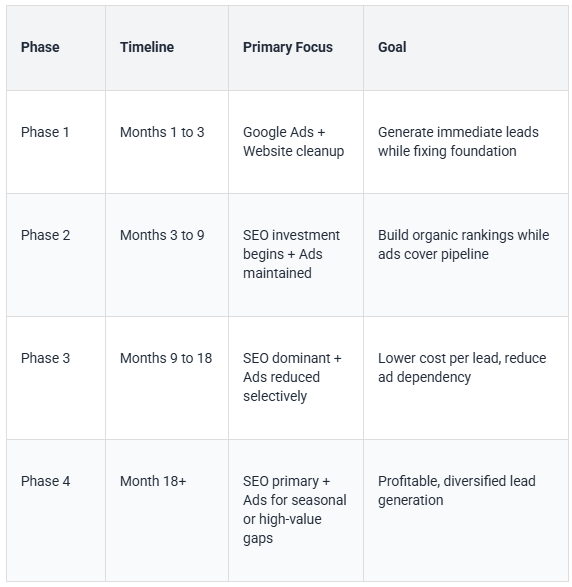
This isn't the only way to approach it, but it reflects what tends to work in practice for service businesses with average job values above $1,500.
Frequently Asked Questions
Which is better for fast leads?
Google Ads wins hands down for speed. A properly set up campaign can start delivering calls within the first week. SEO requires months of consistent work before generating a reliable lead flow. If your business needs work in the next 30 to 60 days, ads are the right tool for that specific problem.
Which is better for long-term ROI?
SEO produces better long-term ROI for most contractors. Once strong rankings are established, the cost per lead tends to be significantly lower than paid advertising. The compounding nature of SEO means your past investment continues generating returns, unlike ads where every dollar spent expires the moment the campaign pauses.
Which one do customers trust more?
Organic results generally carry more trust than paid ads, particularly for high-consideration purchases like home renovation and contracting services. Homeowners who are spending thousands of dollars tend to research carefully, and contractors who appear in organic results with strong reviews are often perceived as more established and credible. That said, a well-crafted ad with strong social proof can still convert effectively.
What happens when I stop paying?
With Google Ads, your visibility stops the moment your budget runs out or your campaign pauses. With SEO, your rankings don't disappear overnight. They degrade gradually over months if work stops, but the equity you've built persists. Many contractors take a month off SEO investment and barely notice a change, whereas pausing ads for a week can mean zero inbound calls.
Can I use both simultaneously?
Yes, and for many contractors, using both channels at the same time is the most effective approach. Ads handle short-term lead flow while SEO builds long-term organic authority. The data from your ad campaigns can also inform your SEO strategy by revealing which keywords convert best in your specific market, giving you a smarter starting point for content and optimization work.
Which Channel Is Right for Your Contracting Business?
If you need leads this month, Google Ads solves that problem. If you want a business that generates inbound calls without writing a check for every single click, SEO is what gets you there. The smartest contractors aren't choosing one or the other in isolation. They're building a strategy where paid ads fund short-term growth while SEO creates a compounding asset that reduces long-term marketing costs.
The trap to avoid is letting urgency push you into ad dependency indefinitely. Every month you delay building organic visibility is a month your competitors are pulling further ahead in search rankings.
At Booked and Built, we work specifically with contractors to develop marketing strategies that make sense for your trade, your market, and your growth stage. Whether you're trying to reduce your ad spend or build rankings from scratch, the goal is always the same: a full calendar with leads that actually close.
Ready to find out where your contracting business stands online? Reach out to Booked and Built and get a clear picture of what's working, what isn't, and what the right next step actually looks like for your specific situation.