Google Ads for Contractors: How to Get Leads That Actually Book Jobs
Google Ads can generate fast, high-intent leads for contractors by placing your business in front of people actively searching for services right now.
Google Ads can generate fast, high-intent leads for contractors by placing your business in front of people actively searching for services right now. Success depends on choosing the right campaign type, targeting service-specific keywords, setting a realistic budget, and sending traffic to a landing page built to convert. Contractors who get those fundamentals right tend to see a measurable return within the first 60 to 90 days.
Most contractors try Google Ads at some point, and a lot of them walk away feeling like it burned through budget without much to show for it. The problem is rarely the platform itself. It's usually the setup. When campaigns are built around how contractors think about their business rather than how customers search for it, results suffer. This guide breaks down what actually works, what drains budget quietly, and how to build a campaign that turns clicks into booked jobs.
Key Takeaways
- Google Ads work best for contractors when campaigns target high-intent, service-specific keywords rather than broad or informational searches.
- Search campaigns and Local Services Ads are typically the strongest starting point for most trades before layering in Performance Max.
- Your landing page matters as much as the ad itself. A disconnect between what your ad promises and what the page delivers will kill conversions.
- The first 30 to 60 days should be treated as a learning phase, not a final verdict on whether the campaign works.
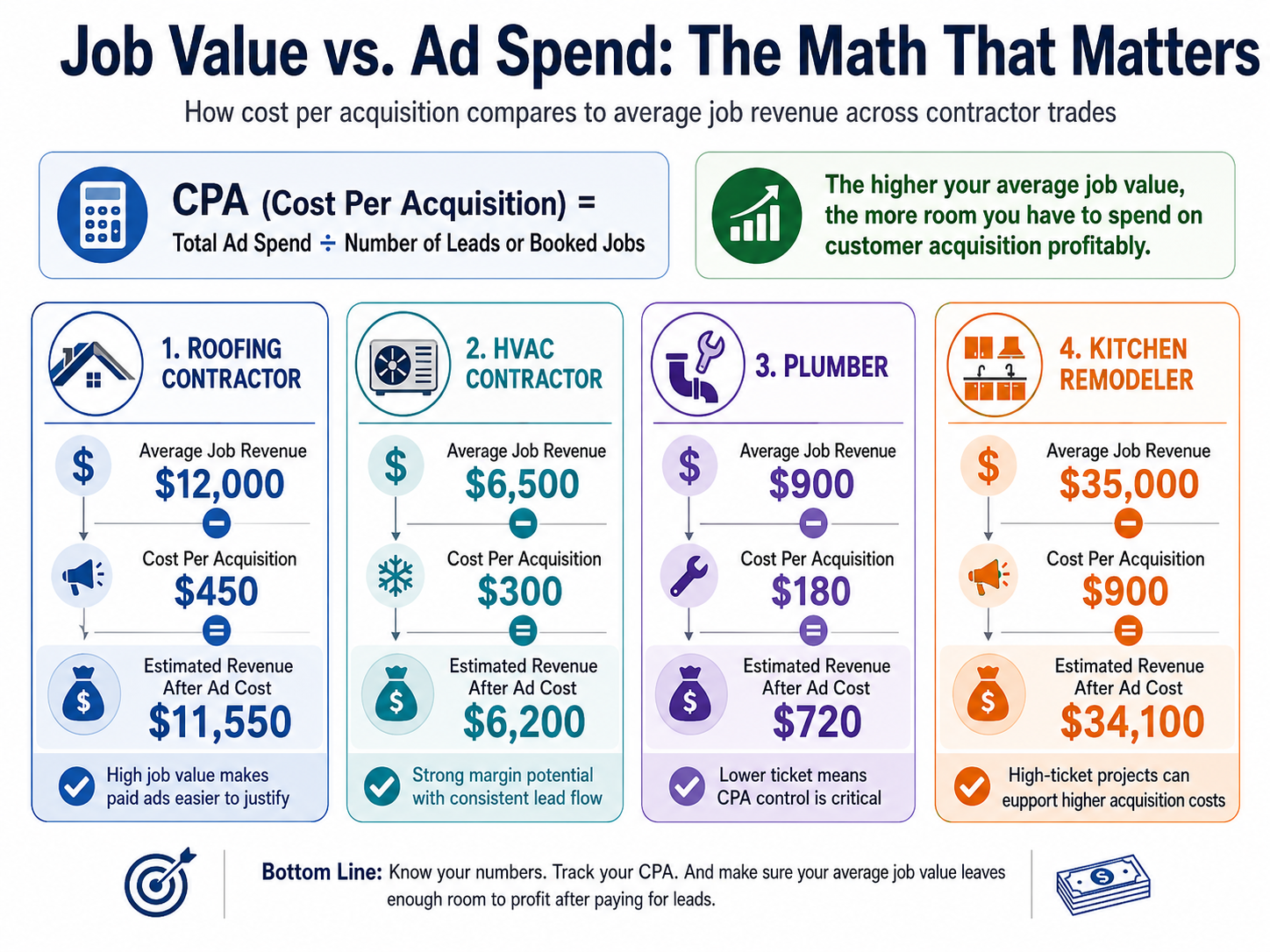
- Budget should be sized relative to your average job value so that even a modest conversion rate produces a positive return.
- Ongoing optimization is not optional. Campaigns that run without regular review tend to drift toward inefficiency over time.
Things You Must Know
1. Broad Match Keywords Will Drain Your Budget Fast
If you're running ads without tightening your keyword match types, Google will show your ads for searches that have nothing to do with your actual service. A roofing contractor bidding on "roofing" with broad match might end up paying for clicks from people looking for roofing tutorials, roofing materials, or DIY guides. Using phrase match and exact match for your core service terms, combined with a solid negative keyword list, is one of the most immediate ways to stop wasted spend.
2. A Weak Landing Page Negates a Strong Ad
Many contractors send Google Ads traffic to their homepage and wonder why nobody calls. Your homepage is designed to introduce your business. A landing page is designed to convert one specific type of visitor into a lead. Each service you're advertising deserves its own dedicated page with a clear headline, a direct value proposition, and an obvious next step. Even a modest improvement to your landing page experience can significantly shift your cost per lead.
3. Local Services Ads and Search Ads Serve Different Purposes
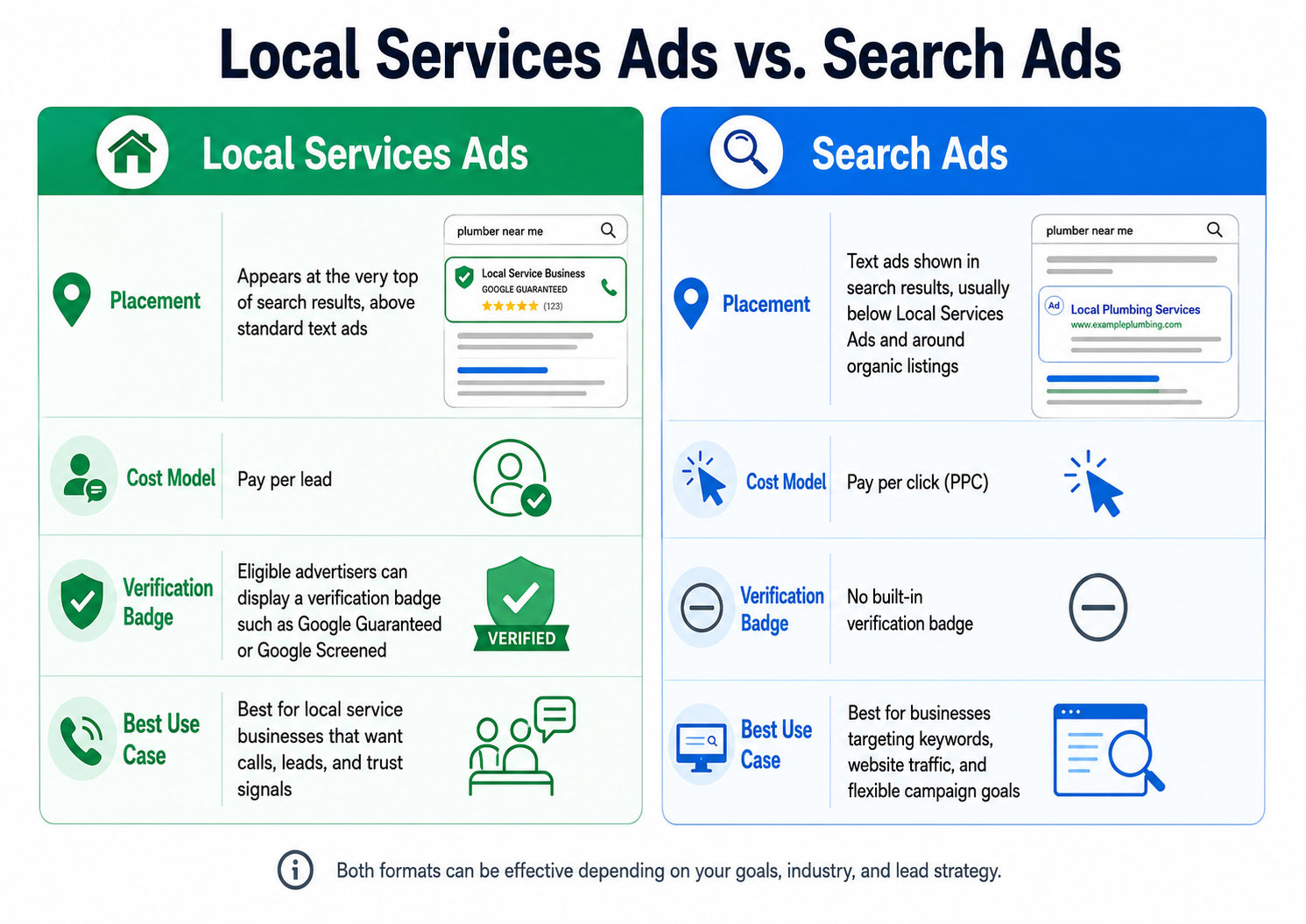
Local Services Ads (LSAs) appear above standard search results and charge per lead rather than per click, which appeals to many contractors. They also carry Google's verification badge for eligible trades, which builds trust quickly. Standard Search campaigns give you more control over keywords, ad copy, and bidding strategy. Both have a place in a mature contractor ad strategy, but understanding how they work differently helps you allocate budget more intelligently from the start.
What Makes Google Ads Different for Contractors?
Unlike social media advertising, Google Ads intercept demand rather than create it. When someone searches "emergency HVAC repair" or "licensed electrician near me," they've already decided they need help. Your ad shows up at exactly that moment. That intent gap is why Google Ads can produce fast results for contractors in ways that brand awareness channels can't replicate.
The trade-off is cost. Contractor-related keywords sit in competitive territory on Google, which pushes click prices up. Paying for clicks without a system to convert them into calls is where most contractor campaigns fall apart.
Which Campaign Types Work Best for Contractors?
Search Campaigns
Search campaigns remain the strongest starting point for most contractors. You bid on specific keywords, write ads that match the search intent, and pay when someone clicks. The control you have over keywords and ad copy makes it easier to stay focused on the services that actually bring in revenue.
For service businesses, bottom-of-funnel keywords outperform everything else. These are phrases like "roof replacement quote," "plumber available today," or "fence installation contractor." They signal buying intent rather than curiosity.
Local Services Ads
Local Services Ads appear above both paid Search ads and organic results for many service-related queries, giving contractors prime placement at the top of the page. Eligible trades include HVAC, plumbing, electrical, roofing, general contracting, and several others. Businesses that pass Google's verification process earn a "Google Guaranteed" or "Google Screened" badge, which research suggests increases consumer trust and click-through rates compared to unverified listings.
Because LSAs charge per lead rather than per click, the cost model is different from Search campaigns. For contractors getting started, LSAs can be a lower-risk entry point, though availability varies by trade and location.
Performance Max
Performance Max runs across all of Google's channels, including Search, Display, YouTube, and Gmail. It uses automation to find conversions, which sounds appealing but requires substantial conversion data to optimize well. Most contractors see better early results from focused Search campaigns. Performance Max tends to work better as a complement once your account has a track record to learn from.

How Much Should Contractors Budget for Google Ads?
In competitive contractor trades like HVAC and roofing, cost-per-click for high-intent keywords can range from several dollars to well over twenty dollars depending on the market and the specific keyword. Larger metros with multiple competing advertisers tend to push click prices higher. Smaller regional markets often offer more affordable entry points with less competition for the same search terms.
There's no single number that works for every contractor. The right way to think about budget is through the lens of job value. If a single booked job is worth $3,000 to your business, spending $600 to acquire that lead still produces a strong return even after overhead.
A practical starting budget is large enough to generate meaningful data within 30 days. For many contractors, that falls somewhere between a few hundred and a few thousand dollars per month, scaled to the competitiveness of the trade and location. Starting too small means the algorithm doesn't get enough data to optimize, and you can't draw meaningful conclusions about what's working.
If you're weighing whether paid ads or organic search is the right fit for your stage of growth, the comparison between SEO vs Google Ads for contractors is worth reviewing before you commit budget in one direction.
How to Set Up a Google Ads Campaign as a Contractor: Step by Step
- Define your core services and service area. Don't try to advertise every service at launch. Pick your highest-margin or highest-demand service and focus the first campaign on that. Define your geographic targeting tightly to the areas you actually serve and want more work in.
- Build a dedicated landing page. Before you write a single ad, set up a landing page specific to that service. It should have a headline that matches what the ad promises, a brief explanation of what you offer, trust signals like reviews or credentials, and a clear way to contact you (phone number and a short form).
- Research your keywords. Use Google Keyword Planner or a comparable tool to identify the service-specific phrases your target customers search. Focus on phrases that indicate someone is ready to hire, not just researching. Build a negative keyword list from the start to filter out irrelevant searches.
- Write your ads. Each ad group should focus on a tight cluster of related keywords. Your headline should speak directly to the search intent. Include a clear offer or differentiator in the description, whether that's same-day availability, licensed and insured, free estimate, or something else specific to your business.
- Set your bidding strategy. For new campaigns without conversion history, Manual CPC or Maximize Clicks gives you the most control. Once you've gathered 30 to 50 conversions, you can test automated strategies like Target CPA or Maximize Conversions with a cap.
- Enable conversion tracking. This is non-negotiable. Track phone calls from ads and from your landing page, form submissions, and any other actions that indicate a lead. Without conversion tracking, you're optimizing blind.
- Launch and monitor daily for the first two weeks. Watch for search terms triggering your ads that don't belong there, and add them to your negative keyword list. Check impression share, click-through rate, and most importantly, whether calls and form fills are coming in.
Why Are My Google Ads Getting Clicks but No Calls?
This is one of the most common frustrations for contractors running their own campaigns. Traffic without conversions almost always points to one of a few issues.
The most common cause is a mismatch between the ad and the landing page. If your ad says "Free Roof Inspection" but the landing page talks about your company history and has no obvious way to request an inspection, visitors leave. The ad created an expectation the page didn't deliver.
Page load speed is a significant factor in mobile conversion rates, with studies suggesting that delays of even a few seconds can substantially increase bounce rates for service-based landing pages. Given that a large share of contractor-related searches happen on mobile devices, a slow or poorly formatted mobile landing page is a common silent killer for contractor ad campaigns.
Other causes include targeting keywords with informational intent (people researching, not buying), sending all traffic to a homepage instead of a service-specific page, or having no click-to-call button visible above the fold on mobile. Fixing these issues one at a time, while tracking what changes, gives you the clearest picture of what's actually moving the needle.
Common Mistakes Contractors Make With Google Ads
- Running campaigns without conversion tracking. If you don't know which keywords and ads are producing calls, you can't improve. This is the single most important setup step and also the most commonly skipped.
- Targeting too broad a geographic area. Wider isn't better if you can't service the jobs. Geographic overbidding inflates costs and generates leads you either can't fulfill or don't want.
- Letting campaigns run without review. Google's algorithm will spend your budget regardless of performance. Weekly check-ins on search terms, CTR, and conversion data are the minimum required to keep a campaign on track.
- Using only one ad variation per ad group. Testing multiple headlines and descriptions tells you what language resonates with your audience. Running a single variation gives the algorithm nothing to optimize against.
- Pausing campaigns too early. Many contractors shut campaigns down after two or three weeks of slow results. The learning phase takes time. Pulling the plug too early means you never reach the point where the campaign starts performing consistently.
- Ignoring Quality Score. A low Quality Score means you pay more per click than competitors with better ad relevance and landing page experience. Improving ad copy alignment with keywords and landing page content can lower your costs without raising your budget.

How Do Google Ads Compare to SEO for Contractors?
Both channels drive leads, but they work on different timelines and serve different purposes. Google Ads produce results as soon as campaigns go live. SEO builds over months and, once established, generates leads at a lower ongoing cost per acquisition.
Industry data consistently shows that organic search results tend to capture a higher share of total clicks than paid ads for most search queries. However, for high-intent, service-based searches, paid placements at the top of the page capture a meaningful share of clicks, particularly on mobile where above-the-fold real estate is limited.
Most contractors in growth mode benefit from running both. Google Ads fills the pipeline immediately while SEO compounds over time. If you're curious about how long SEO takes to produce results for contractors, that's a useful benchmark to set alongside your paid strategy.

Frequently Asked Questions
Are Google Ads worth it for contractors?
Google Ads can be highly effective for contractors because they put your business in front of people actively searching for services you offer right now, rather than waiting for organic rankings to develop over time. The key is targeting high-intent keywords like "roofing contractor near me" or "emergency plumber" that signal someone is ready to hire. Contractors with a clear service area, a well-converting landing page, and a realistic budget tend to see strong returns. That said, poorly structured campaigns can burn through budget quickly, so setup and ongoing optimization carry a lot of weight.
How much should a contractor budget for Google Ads?
There's no universal budget that fits every contractor, since costs vary by trade, location, and competition level. In competitive markets like HVAC or roofing, cost-per-click can range from several dollars to well over twenty dollars depending on the keyword. A practical starting point is a budget large enough to generate meaningful data within 30 days, which typically falls somewhere between a few hundred and a few thousand dollars per month, scaled to the value of a single job. The most important principle is aligning your budget with your average job value so that even a modest conversion rate produces a positive return.
What types of Google Ads campaigns work best for contractors?
Search campaigns targeting bottom-of-funnel, service-specific keywords tend to perform best for contractors because they capture people who are already looking to hire. Local Services Ads, which appear above standard search results and include a Google Guaranteed badge, are also highly valuable for eligible trades. Performance Max campaigns can extend reach across Google's network but typically require more data and budget to optimize effectively. Most contractors see the strongest results starting with focused Search campaigns before layering in other campaign types.
Why are my Google Ads getting clicks but no calls or leads?
Click traffic that doesn't convert usually points to a disconnect between the ad and the landing page experience. If your ad promises a free estimate but the landing page buries the contact form or lacks a clear call to action, visitors will leave without reaching out. Other common causes include slow page load times on mobile, landing pages that are too generic, or targeting keywords with informational rather than commercial intent. Testing a dedicated page per service, aligned directly to the ad's promise, often resolves conversion drop-off.
How long does it take for Google Ads to start generating leads for a contractor?
Most contractor campaigns begin generating some lead volume within the first one to two weeks once ads are approved and budgets are live. The first 30 to 60 days should be treated as a learning phase where the algorithm is gathering data and you're identifying which keywords, ad copy, and landing pages perform best. Reliable lead flow typically stabilizes around the 60 to 90 day mark. Setting realistic expectations upfront, and resisting the urge to make drastic changes too early, gives campaigns the best chance to mature into a consistent lead source.
Getting the Most Out of Google Ads as a Contractor
Google Ads isn't a set-it-and-forget-it system, and it's not a shortcut that bypasses the need for a strong website and clear service positioning. When those foundations are in place, paid search becomes a highly controllable lead generation channel that you can scale up or pull back depending on your capacity.
The contractors who get the best results aren't necessarily spending the most. They're spending with the most intention, targeting the right keywords, sending traffic to pages built to convert, and reviewing performance regularly enough to improve over time.
If you're also building out your organic presence, the same keyword research that informs your ad strategy can guide your SEO content. Booked and Built works with contractors to build lead generation systems that cover both channels, so growth doesn't depend entirely on ad spend. Reach out to the team at Booked and Built to talk through what a paid search strategy built around your trade and service area would look like.