Local SEO for Contractors: What Actually Drives Rankings and Leads
Local SEO for contractors is the process of optimizing your online presence so your business appears when nearby homeowners search for the services you offer.
Local SEO for contractors is the process of optimizing your online presence so your business appears when nearby homeowners search for the services you offer. The highest-impact actions include a fully completed Google Business Profile, consistent business information across directories, genuine customer reviews, and a website with dedicated service and location pages. Contractors who combine all of these consistently tend to generate a steady flow of qualified local leads.
Key Takeaways
- Your Google Business Profile is the single most important starting point for local SEO as a contractor.
- Consistent name, address, and phone number (NAP) information across every online directory directly affects your local rankings.
- Customer reviews are both a ranking signal and a trust signal — collecting them consistently matters more than collecting them in bursts.
- A well-structured website with dedicated service and location pages dramatically expands the range of searches you can rank for.
- Local SEO takes time. Most contractors see meaningful results within three to six months of consistent effort.
- AI-powered search engines like Google AI Overviews and Perplexity pull from website content, so contractors without a website miss out on that visibility entirely.
Most homeowners don't flip through directories or ask neighbors anymore. They open Google, type something like "deck builder near me" or "roofing contractor in [city]," and call whoever shows up first. If your contracting business isn't showing up in those results, you're not losing to a better contractor — you're losing to a more visible one. This guide breaks down exactly how local SEO works for contractors and what you should actually be doing about it.
Things You Must Know
1. Visibility and credibility are not the same thing
Ranking on Google gets you seen. But what homeowners find when they click — your reviews, your photos, your website content — determines whether they actually call you. Many contractors invest in rankings without building the profile quality and website depth that converts visitors into leads. Both sides of that equation matter.
2. Inconsistent business information quietly hurts your rankings
If your business name, address, or phone number appears differently across Google, Yelp, Houzz, Angi, and other directories, search engines lose confidence in your listing. That inconsistency is a ranking suppressor most contractors don't realize is working against them. Auditing and correcting your citations is one of the highest-ROI fixes available, especially for businesses that have moved locations or changed phone numbers.
3. Local SEO is cumulative, not instant
Each review you collect, each page you publish, and each citation you fix adds to a compounding foundation. Contractors who treat local SEO as a one-time setup rarely hold their rankings. Those who treat it as an ongoing process — adding reviews, updating their profile, publishing new content — tend to build ranking stability that paid ads can't replicate.
What Is Local SEO and Why Does It Matter for Contractors?
Local SEO is the practice of optimizing everything about your online presence so that search engines connect your business to nearby customers looking for what you do. For contractors, that means showing up in Google's local map pack (the three business listings that appear above organic results), in local organic search results, and increasingly in AI-generated answers that pull from authoritative local sources.
The stakes are high. A significant share of people searching for a contractor online contact one of the first few businesses they see. Ranking on page two or being absent from the map pack isn't a minor inconvenience — it's a consistent drain on your lead pipeline.
Unlike paid ads, which stop producing leads the moment you stop paying, strong local SEO builds a presence that generates leads passively over time. That's why contractors who get it right tend to rely less on expensive lead generation platforms and more on inbound calls from people who found them organically.

How Does Google Decide Which Contractors to Show Locally?
Google uses three primary factors to determine local rankings: relevance, distance, and prominence. Understanding each one helps you prioritize where to put your energy.
- Relevance is about how well your business matches what the searcher is looking for. A roofing contractor whose Google Business Profile and website clearly describe roofing services will rank better for roofing searches than a general contractor whose profile is vague about what they actually do.
- Distance is how close your business location (or stated service area) is to the person searching. You can't change your physical address, but you can make sure your service area is clearly defined in your Google Business Profile.
- Prominence is where most of your actual influence sits. It's a measure of how well-known and trusted your business appears online, based on reviews, backlinks, citations, and the quality of your overall web presence.
How to Optimize Your Google Business Profile as a Contractor
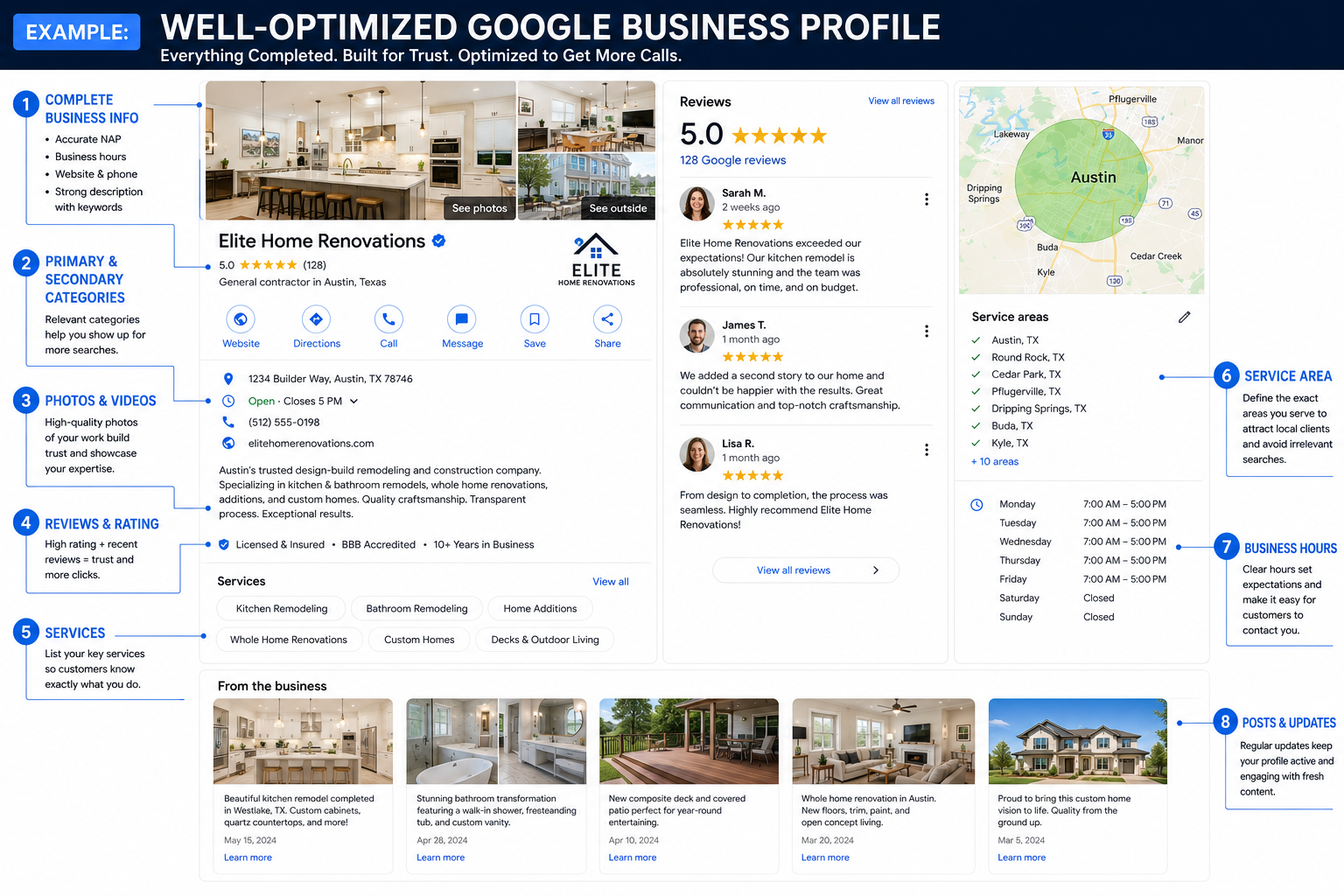
Your Google Business Profile (GBP) is the most direct lever you have for local visibility. It feeds the map pack, influences AI-generated answers, and is often the first thing a potential client sees before they even visit your website.
Here's how to approach it properly:
- Claim and verify your profile if you haven't already. An unclaimed listing is editable by anyone and often contains errors.
- Select precise primary and secondary categories. "Roofing Contractor" or "General Contractor" should be your primary; additional services can go in secondary categories.
- Write a detailed business description that explains what you do, where you work, and what sets you apart. Avoid vague language.
- Add your service areas explicitly. List every city, town, or region you genuinely serve.
- Upload project photos regularly. Before-and-after photos of completed work signal an active, credible profile. Profiles with strong photo libraries consistently outperform those without.
- Enable and respond to Q&A. Pre-populate common questions (services offered, service area, licensing) so potential clients find answers fast.
- Post updates at least monthly. New projects, seasonal promotions, or helpful tips keep your profile active in Google's eyes.
Businesses with complete Google Business Profiles are significantly more likely to be considered reputable by consumers, and profiles with photos receive considerably more direction requests and website clicks than those without images.
Why Customer Reviews Are a Contractor's Most Powerful Ranking Tool
Reviews do two things simultaneously: they influence your local ranking, and they influence whether someone who finds you actually calls. That dual function makes review generation one of the highest-value activities in local SEO for contractors.
The most effective approach is simple and systematic. After every completed project, ask your client directly — either in person or via a brief follow-up text or email — to leave a Google review. Most satisfied clients are willing to help; they just need a direct ask and an easy link.
A large majority of consumers read online reviews before choosing a local service provider, and the recency of reviews matters as much as the overall star rating — older reviews carry less weight than a consistent flow of recent ones.
Responding to every review, positive or critical, also matters. Thoughtful responses signal professionalism and show potential clients how you handle your business. For roofing contractors specifically, this kind of visible reputation management ties directly into how AI systems and Google assess your authority in local searches. If you're working through how SEO for roofing contractors applies to your niche, the principles overlap closely with what's covered here.
What Role Does Your Website Play in Local SEO?
Your website is where your Google Business Profile sends people to learn more, evaluate your work, and decide whether to contact you. But it's also a direct ranking asset in its own right.
A well-structured contractor website should have:
- A dedicated page for each core service (roofing, siding, decking, etc.) rather than one generic "services" page
- Location pages or service-area content for each city or region you target
- Clear contact information on every page, matching exactly what's in your Google Business Profile
- Project photos with descriptive file names and alt text
- A simple structure that loads quickly on mobile devices
The majority of local service searches happen on mobile devices, meaning a slow or poorly formatted website can cost a contractor leads even when their local ranking is strong.
If you're in the process of building or rebuilding your site, choosing the right platform matters for how well it supports SEO. Reviewing the options for website builders for SEO can help you make that decision with local optimization in mind from the start.
Local SEO vs. Google Ads: Which Should Contractors Prioritize?

Most established contractors benefit from using both, but local SEO should be the foundation. It's worth understanding the full picture of SEO vs. Google Ads for contractors before deciding how to allocate your marketing budget.
Common Local SEO Mistakes Contractors Make
- Ignoring their Google Business Profile after setup. A profile that isn't regularly updated with new photos, posts, or responses gradually loses ground to competitors who are actively managing theirs.
- Using inconsistent business information. Even small differences in how your address or phone number appears across directories can suppress your local rankings.
- Having no dedicated service pages on their website. One generic "services" page can't compete with individual pages optimized for specific searches like "deck installation in [city]."
- Not asking for reviews systematically. Waiting for clients to leave reviews on their own results in a trickle when a steady stream is what actually builds ranking momentum.
- Focusing only on rankings and ignoring conversion. Getting to the top of local results means nothing if your profile and website don't give visitors a reason to call.
- Expecting overnight results. Contractors who abandon their local SEO efforts after a few weeks because they don't see immediate changes miss out on the compounding benefit that comes at the three-to-six-month mark.
How Long Does Local SEO Take for Contractors?
Realistic expectations matter here. Quick wins from profile optimization or fixing citation errors can show up within weeks. But meaningful movement in competitive local markets typically takes three to six months of consistent effort, and in densely competitive areas it can take longer.
Most SEO professionals working in local services report that sustainable ranking improvements for competitive contractor categories require a minimum of four to six months of consistent optimization activity before results stabilize.
For a more detailed breakdown of timelines by market type and contractor category, the guide on how long SEO takes for contractors covers that in depth.
Local SEO Ranking Factors: A Quick Reference

Frequently Asked Questions
What is local SEO and why does it matter for contractors?
Local SEO is the process of optimizing your online presence so your contracting business appears in search results when nearby customers look for the services you offer. For contractors, this means showing up in Google's local map pack, local organic results, and AI-powered answer engines when someone searches for terms like "roofer near me" or "general contractor in [city]." Most homeowners begin their search for a contractor online, so ranking prominently in local results directly impacts how many qualified leads you receive. Without local SEO, even a highly skilled contractor can lose work to competitors who are less experienced but more visible.
How do I get my contracting business to show up on Google Maps?
To appear on Google Maps, you need to claim and fully optimize your Google Business Profile — this is the single highest-impact step for local SEO as a contractor. Fill out every section completely: business name, address, phone number, website, service categories, service areas, hours, and a detailed business description. Consistently collecting authentic reviews from past clients strengthens your local ranking and builds trust with new prospects. Uploading photos of completed projects also signals to Google that your profile is active and credible. Businesses with complete, regularly updated profiles consistently outrank those with sparse or neglected listings.
How long does local SEO take to show results for a contracting business?
Most contractors begin to see measurable improvements in local rankings and website traffic within three to six months of consistently applying local SEO practices, though competitive markets may take longer. Quick wins — like optimizing your Google Business Profile or fixing inconsistent business listings across the web — can produce noticeable results within weeks. Longer-term strategies such as building local backlinks, publishing location-specific service pages, and accumulating reviews compound over time and deliver more durable ranking improvements. Local SEO is not a one-time fix, and contractors who treat it as an ongoing process tend to see the most sustainable lead flow.
What are the most important local SEO factors for contractors?
The most impactful local SEO factors for contractors are a fully optimized Google Business Profile, consistent NAP (name, address, phone) information across all online directories, a steady stream of genuine customer reviews, and a website with dedicated pages for each service and location you serve. Backlinks from locally relevant websites such as suppliers, trade associations, or local news outlets also carry significant weight. On your website, using clear service-area language and structuring content around the specific problems homeowners search for helps both Google and AI search engines understand what you do and where you do it. Contractors who address all of these factors together tend to outperform those who focus on only one or two.
Do contractors really need a website, or is a Google Business Profile enough?
A Google Business Profile alone is not sufficient for competitive local SEO — a professional website works alongside it to significantly improve your visibility and credibility. Your website allows you to create dedicated pages for each service and location, which gives Google more signals to rank you across a wider range of searches. It also serves as the destination where potential clients vet your work, read detailed service descriptions, and convert into actual leads. AI-powered search tools like Google's AI Overviews and Perplexity draw on website content when generating answers, so contractors without a website miss out on that visibility entirely. Together, a strong Google Business Profile and a well-structured website form the foundation of effective local SEO for any contracting business.
Start Building a Local Presence That Actually Generates Leads
Local SEO isn't a hack or a shortcut — it's a sustained process of making your business easier to find, easier to trust, and easier to choose. The contractors who consistently win in local search are the ones who treat their online presence with the same care they put into their actual work.
If you're ready to stop leaving leads on the table and start building a local presence that works for you month after month, Booked and Built helps contractors do exactly that. Reach out at bookedandbuilt.net to get started.